
WordPress Development
My approach to web development
I have been working with web projects since 2012, and WordPress is my platform of choice for building reliable digital products, not just websites.
I specialize in full-cycle development, with attention to architecture, security, performance, scalability, and fault-tolerant integrations.
For me, technical aspects of a project and the experience of people who work with the system — managers, editors, and content creators — are equally important.
The most common areas of my work include B2C and B2B WooCommerce stores, as well as media portals and content platforms.
Experience and context
Over the years, I have built and maintained custom systems, worked with Bitrix, UMI CMS, and MODx, and had hands-on experience with Drupal, Joomla, and Yii. I also studied Laravel, Django, and Java-based web development, but did not find advantages that would justify the higher development and maintenance costs for most real-world projects.
This experience led me to a conscious decision to choose WordPress — not as a “simple solution,” but as a platform that, with well-designed architecture, provides a solid foundation for stable long-term project development.
I have been contributing to WordPress and its ecosystem since 2019.
My profile: https://profiles.wordpress.org/oglekler/
Public talks and professional community
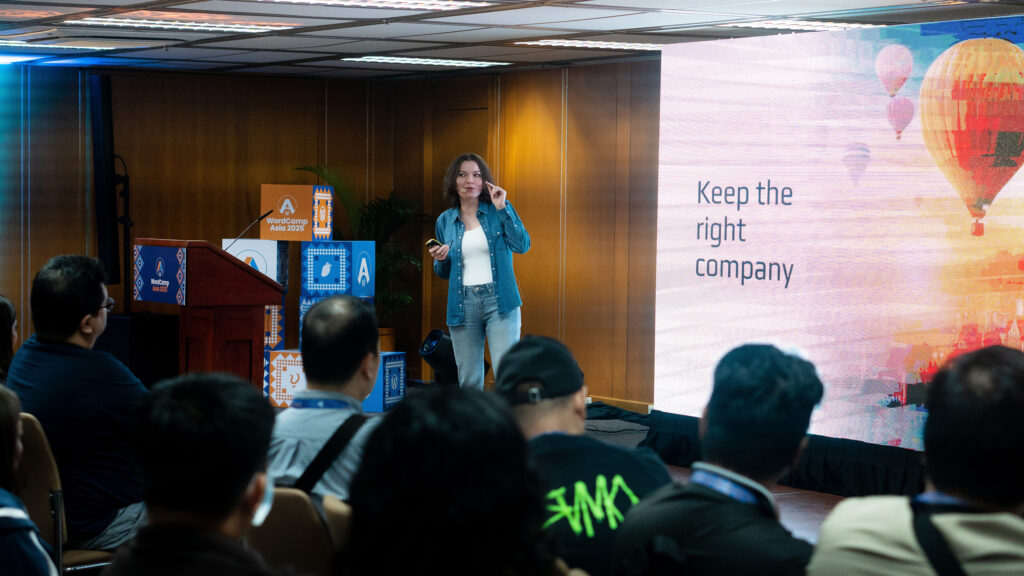
I regularly speak at professional conferences and meetups, sharing hands-on experience in WordPress development — from security and best practices to architectural decisions and real project constraints.
Some of my talks in the WordPress community are available on WordPress.tv:
https://wordpress.tv/speakers/olga-gleckler/
Why WordPress
WordPress is an actively developed platform with a clear and reliable release model, low system requirements, and a mature ecosystem.
Its key strengths include:
- fast project and MVP launch
- ability to extend functionality without changing the platform
- a mature ecosystem of plugins and integrations
- the Block Editor, which allows building a predictable and convenient editing experience
- lower maintenance costs compared to custom frameworks
At the same time, this does not reduce the responsibility of the developer. On the contrary, WordPress requires well-considered and balanced decisions from the very beginning.
The other side of the advantages
WordPress is easy to install and provides a working website “out of the box.”
In practice, this often becomes a source of problems.
I have encountered projects where:
- architecture is completely absent
- each new requirement is solved by adding yet another plugin
- code is fragmented and lacks any system
- responsibility for project development is unclear
- documentation is missing
- experiments are conducted directly on production
As a result, owners end up with slow, unstable, and poorly scalable projects that fail to meet both user expectations and business needs. Attempts to fix the situation with optimization plugins may temporarily reduce symptoms, but they do not solve the core problem — which is not WordPress itself, but the way it was used from the start.
This is how the myth that “WordPress is not suitable for serious projects” appears, despite numerous examples of large, high-load systems running reliably on WordPress.
How to avoid these issues
WordPress allows teams to build an MVP quickly and test a hypothesis fast — as long as trade-offs are understood from the beginning.
For stable project growth, it is important to:
- have a person responsible for architecture and long-term development
- plan for growth already at the MVP stage
- not wait until the system breaks under load or stops meeting user expectations
In practice, every web project requires ongoing attention and active work after launch — not only on the technical side, but also on content.
Users come for content: products, articles, news, or anything else. Launch is only the beginning. Projects that freeze right after release gradually become obsolete — like a shop window with plastic mannequins: the clothes collect dust, and people passing by stop noticing it.
How I work
In projects, I focus on:
- designing architecture with future growth in mind
- researching and selecting plugins deliberately
- setting up roles, access rights, and content workflows
- planning for maintainability and long-term development
My goal is to build a product that:
- meets business needs
- is convenient to use
- does not rely on constant workarounds
- can grow without migrating to another platform
When this approach is a good fit
We will work well together if a project:
- values reliability over speed alone
- is launched with long-term growth in mind
- requires thoughtful technical and product decisions
I do not take on requests like “only optimization is left” or “we need the same thing, but cheaper and faster.”
I enjoy working on ambitious projects where there is room for design, discussion, and growth.